CBRT™: visual mindfulness for communication and measurable outcomes

A first-tier, person-centred mental-health intervention combining visual focus, conscious breathing, caring communication and structured whole mind-body relaxation.

"Mindfulness is the development of the ability to pay deliberate attention to our experience from moment to moment, to what is going on in our mind, body and day to day life and doing this without judgement." 

How CBRT™ uses visual mindfulness

CBRT™ is a form of visual mindfulness which has been in continuing development since 1997. It uses the seven uniquely designed Colour Breathing Disks© as a visual point of focus, together with conscious breathing, caring communication and structured whole mind-body relaxation.

The participant is not expected to empty their mind. A trained CBRT™ Practitioner supports them to focus, notice their responses and communicate any thoughts, feelings, physical sensations or emotions they wish to share. This person-centred communication process is a distinctive feature of CBRT™ as a mental-health intervention.


Outcomes recorded by CBRT™ Practitioners during their Training Programme Assessment as case studies in service delivery

CBRT™ Initial Response Sheets© form a central part of the Programme’s innovative approach to mental-health communication. Developed and used since 2006, they provide a structured starting point for person-centred conversations, helping participants communicate visual preferences, thoughts, feelings, physical sensations and emotional responses that may otherwise be difficult to express.

By capturing structured responses to the seven Colour Breathing Disks© across participants and sessions, the CBRT™ Initial Response Sheets© also create a distinctive dataset with potential relevance to research into mental-health communication, visual perception and colour science.

CBRT™ Practitioners also use recognised measures, including GAD-7 and PHQ-9, together with wellbeing statements. These tools provide a structured record of participants’ experiences and any changes recorded across a series of sessions.

From 2027, clients of CBRT™ Practitioners will have access to CBRT™ Observation Diaries© in both printed and app-based formats.

From early innovation to wider recognition

CBRT™ had already been in continuing development for more than a decade when wider public discussion about mindfulness began to grow.

On 5 January 2010, the Daily Mail reported: “Patients with depression should be routinely given £300 meditation courses on the NHS, doctors' claim”. The article stated that mindfulness techniques could produce “massive savings” by halving the risk of depression returning and that “only one in 20 family doctors are prescribing such treatment”, according to a Mental Health Foundation report.

More recent research and media coverage about Mindfulness

A randomised clinical trial published online in 2022 in JAMA Psychiatry found that an eight-week Mindfulness-Based Stress Reduction Programme was noninferior to escitalopram for adults with anxiety disorders.

In September 2023, BBC Future examined mindfulness, stress and the brain. Professor Thorsten Barnhofer explained: “What mindfulness does is it can buffer stress; you become aware of challenges.”

In August 2024, ScienceDaily reported research from the Universities of Bath and Southampton. Researcher Masha Remskar said: “This study highlights that even short, daily practices of mindfulness can offer benefits, making it a simple yet powerful tool for enhancing mental health.”

These reports relate to wider mindfulness research and are not CBRT™ clinical trials. They demonstrate how public and scientific interest in mindfulness and structured relaxation has developed since the original 2010 report.

SOURCE LINKS

JAMA Psychiatry — Mindfulness-Based Stress Reduction compared with escitalopram

BBC Future — How I rewired my brain in six weeks

ScienceDaily — Just 10 minutes of mindfulness daily boosts wellbeing and fights depression

Relaxation and whole-person health

Research into regular relaxation has explored possible benefits for blood pressure and cardiovascular health, including recovery following a heart attack; mental health; immune function; memory; concentration; learning; and coping.

Relaxation can provide a purposeful break from stress and support the brain’s emotional regulation processes. Research has also examined changes in patterns of brain activity during relaxation. Simple calming activities, including spending time with a pet, may also be beneficial.

What mindfulness-based approaches aim to support

• Practical skills for daily challenges and physical or psychological health problems.

• Greater awareness of breathing and present-moment experience.

• Recognition of thought patterns and changes in mood.

• A greater willingness to experience difficult thoughts and emotions.

• Hope, understanding, empathy and more constructive coping.

Colour Breathing One-Day School Trial Results

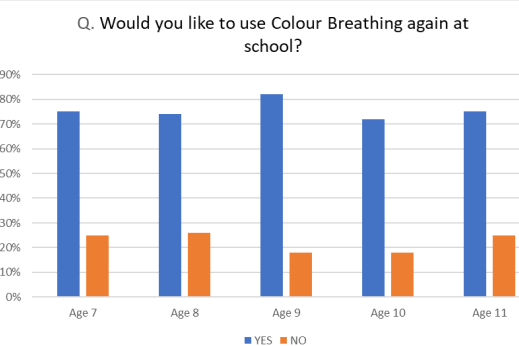
In May 2005, children at Charles Dickens Junior School in Portsmouth took part in a full one-hour Colour Breathing session for relaxation with a Colour Breathing Practitioner they had not met before. Teachers and support assistants also participated.

The existing chart records the children’s answers, by age, to the question: “Would you like to use Colour Breathing again at school?” The majority of children in every age group shown answered yes.

Relaxation and whole-person health

Research into regular relaxation has explored possible benefits for blood pressure and cardiovascular health, including recovery following a heart attack; mental health; immune function; memory; concentration; learning; and coping.

Relaxation can provide a purposeful break from stress and support the brain’s emotional regulation processes. Research has also examined changes in patterns of brain activity during relaxation. Simple calming activities, including spending time with a pet, may also be beneficial.

Development of MBSR and MBCT

Jon Kabat-Zinn developed the eight-week Mindfulness-Based Stress Reduction Programme at the University of Massachusetts Medical Center in 1979. MBSR has been studied in relation to chronic pain, hypertension, heart disease, cancer, gastrointestinal conditions, anxiety and panic.

Zindel Segal, Mark Williams and John Teasdale subsequently adapted this work into Mindfulness-Based Cognitive Therapy for people who had experienced repeated episodes of depression.

Professional boundaries

CBRT™ can form part of a wider mental-health, relaxation or wellbeing support plan. It does not provide a medical diagnosis or replace professional assessment, prescribed treatment or emergency care.

View CBRT™ evidence and participant outcomes

This website is not intended to provide medical diagnosis, advice, treatment, or endorsement.

All rights reserved. CBRT Healthcare Innovation Systems Ltd 2026